
Healing war's wounds D-DAY: A retired nurse, only 22 when she served overseas, recalls the human cost of war Saturday, June 05, 2004
"Nothing except a battle lost can be half so melancholy as a battle
won." - Arthur Wellesley, Duke of Wellington, 1815
She's 85, but it's
clear her voice is the kind that still and always did sound young. "We
used to love to go out on our bicycles. My friend and I were out on a
summer's night, a beautiful evening. And then we heard this low,
humming sound."
The two young women, Canadians who had arrived in
England two years earlier, looked up and saw the dying sunset clouded
by the silhouettes of planes, scores if not hundreds of them, gliders
drifting on towlines behind them. "They were from the base at Reading,
Americans," Gaetane Kerr recalls. "They were taking up their formation,
circling just above us." "It started at about 7 and it went on until
11, when we were ordered to bed," Kerr says.
"Our major said we'd have
work to do tomorrow. "And we did. Not the next day, but the day after."
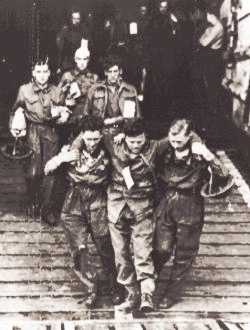
As soon as the wounded of the D-Day invasion could be stabilized and
stretchered onto something that would float, they were shipped off the
beaches and taken to a transport ship that would get them back to
England. Some had been shot; some were missing or about to lose arms or
legs, others blinded by gunfire or shrapnel or debris.
Given the
constraints of the day, it was a pretty good showing that the wounded
started arriving at the Canadian military hospital at Pinewood, outside
London, sometime on June 7. And with the other men and women of the
Royal Canadian Army Medical Corps, Kerr was waiting for them.
She was
the second-youngest of nine children, born in Granby, raised in the
Plateau Mont Royal and enlisted as a nursing sister in 1942, while her
parents were away on summer vacation - although she managed to get her
mother's blessing.
The reality of war's brutality hit young, novice nurse Gaetane
Kerr hard as she tended to the first wave of wounded soldiers to
disembark after the D-Day attack on Normandy. Gaetane Kerr, now 85, saw great suffering.
"I was 22 and you had to be 25," recalls Kerr, who
now lives in St. Donat. She laughingly explains the age restriction by
noting: "You had to be serious and not at all flirtatious. "But they
were sending a French-Canadian hospital over and there was an opening.
That was my stroke of luck."
In England, Kerr got almost 24 months of
utterly civilian nursing, with only military training exercises
requiring her to deal with injuries close to those caused by real
combat. The war across the Channel was manifested only by the
occasional bombing raid over London.
But on the morning of June 7,
1944, the war was real enough: Boatloads landed with 150 wounded at a
time, who were distributed to the 20 Canadian military hospitals.
Kerr's first shock wasn't discovered lying on a stretcher but limping
toward her - a British soldier leaning on a crutch and helped along by
another soldier, also wounded. It wasn't until she looked past the
blood and grime that she saw the Englishman was being supported by a
man wearing the field grey of the Wehrmacht.
"I thought, 'What a silly
war. Here they are, friends, when a few hours before they'd been trying
to kill each other.' " But she adds there were worse moments during the
days that followed June 6, moments where the wounded, euphoric over
having survived, realized the cost of living.
"They talked and talked
at first. They were so happy to be in a Canadian hospital, white
sheets. And they were telling some pretty awful stories. They'd laugh
one minute, then they'd cry, thinking about the friends they'd left
behind. "Then there'd be silence. You could not get a thing out of
them."
In the days before delayed stress syndrome had a name, Kerr
discovered some patients had yet to leave the front line, one knocking
her into the next patient's bed when she tried to change a dressing.
"They were pretty strong." And whether by accident or design, not all
the wounded were Allied soldiers.
"There were other Germans. They
refused blood transfusions; they only wanted their own. There was one,
very young ... lay there with his arm up and said 'Heil Hitler' with
his very last breath. Not his mother, not God, he did not want any
blood and that's how he went.
"I was hysterical once in a while, but I
was trained. I used to go behind a blackout curtain. One minute I'd
laugh, the next I'd cry. Then I'd go back to work. "Someone took a
picture of us just as we walked out of there ... our eyes - it looked
as if we'd seen the devil."
Whatever Kerr saw, it didn't stop her from
applying for assignment to the front. "I trained in Yorkshire. I became
a very good soldier." She went to Belgium, where she saw wounds as bad
as, if not worse than, those after D-Day. She hid in basements to take
shelter from German rocket bombs. "They would start at 11 p.m. and
finish at 1 a.m. ... The Germans were very precise."
She went to the Netherlands, too, where she served in a British hospital that she found so dull, she'd visit Belgium on rare days off "just so we could laugh." Gaetane Kerr, now an 85-year-old resident of St. Donat, was a young army nurse when the first casualties of the D-Day landings began returning to England. The wounded were both Allied and German soldiers, and many were shattered by the horror they had experienced, she recalls.
While stationed in the Belgian city Turnhout, she was befriended by a
French-speaking family that had lost a daughter her age in an air raid.
Funerals seemed a daily event in Belgium, she recalled, but the people
seemed to take the war in stride. "When the V-2s (rockets) would go
over, the Belgians would go outside and shake their fists. Then they'd
go back in and resume playing cards."
When Kerr returned home in 1945,
she found herself missing the men and women she'd shared her life with
for three years, even though she was overjoyed to see her family again.
But then a friend of Kerr, also an army nurse who'd returned to Canada,
had an idea. "My friend told me we could still travel by train for
half-price because we were in uniform.
She had tickets, so we travelled right across the country. "And that was the best transition I could make," Kerr says. "That's when I was home again."